
Wellness by Design
By Julian Mercer
Publication Date: May 19, 2026
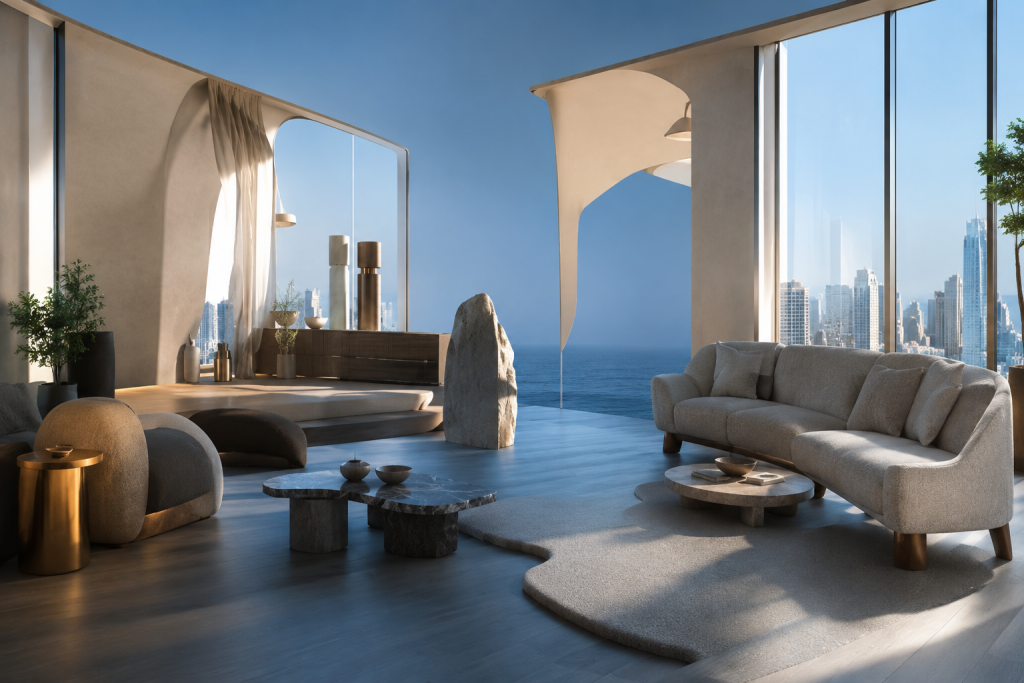
Image Credit:Editorial illustration courtesy of OurSoulsHouse Creative Studio.
For centuries, humanity designed spaces primarily for function.
Buildings were constructed to shelter.
Cities were organised for efficiency.
Rooms were furnished for utility.
But increasingly, modern science is revealing something extraordinary:
The environments humans inhabit do not merely surround them.
They shape them.
Every texture.
Every material.
Every source of light.
Every sound.
Every proportion.
Every spatial experience.
The body responds to all of it.
Quietly.
Continuously.
Biologically.
And this growing understanding is transforming architecture, interiors, hospitality, wellness, and even urban planning itself.
Because the future of design may no longer revolve purely around aesthetics.
It may revolve around human wellbeing.
The Spaces We Occupy Shape Our Nervous System
Modern neuroscience increasingly suggests that physical environments directly influence emotional regulation, cognitive performance, stress response, sleep quality, and even long-term health outcomes.
Harsh lighting can elevate stress.
Noise pollution can increase cortisol.
Lack of natural elements can contribute to psychological fatigue.
Poor spatial design may subtly exhaust the nervous system over time.
Conversely, thoughtfully designed environments can promote calmness, restoration, clarity, focus, and emotional ease.
This is the essence of wellness design:
Creating spaces that support human flourishing rather than merely accommodating human activity.
The Rise of Human-Centred Design
For decades, much of modern architecture prioritised spectacle.
Bigger.
Faster.
More dramatic.
More industrial.
But increasingly, a profound shift is occurring.
Designers are beginning to ask a fundamentally different question:
“How does this space make the human body feel?”
This subtle shift changes everything.
Now, architects, designers, and wellness experts are collaborating around concepts such as:
Circadian lighting
Biophilic design
Acoustic comfort
Air quality optimisation
Natural materials
Sensory harmony
Spatial calmness
Emotional ergonomics
The goal is no longer merely visual beauty.
It is biological harmony.
Why Nature Remains Humanity’s Greatest Designer
Perhaps unsurprisingly, many of the most successful wellness spaces borrow heavily from nature itself.
Natural textures.
Stone.
Wood.
Organic forms.
Flowing light.
Water.
Greenery.
Soft transitions between indoor and outdoor environments.
Human biology evolved in relationship with natural environments for hundreds of thousands of years.
Modern wellness design increasingly recognises that humans do not merely appreciate nature aesthetically.
They regulate through it physiologically.
Even brief exposure to natural environments has been associated in research with reductions in stress markers, improvements in mood, enhanced cognitive restoration, and improved nervous system recovery.
The future of sophisticated design may therefore become less artificial — and more deeply connected to natural intelligence.
Light: The Most Underrated Design Material
Among all elements of wellness architecture, few are more important than light.
Light governs human biology profoundly.
It influences:
Sleep cycles
Hormonal rhythms
Mood regulation
Cognitive performance
Energy levels
Circadian alignment
Poor lighting design can quietly disrupt biological balance for years.
Conversely, intelligently designed lighting environments can support recovery, focus, emotional wellbeing, and restorative sleep.
This is why some of the world’s most forward-thinking spaces now prioritise dynamic lighting systems that align more naturally with human circadian rhythms.
Because wellness is not simply what humans consume.
It is also what surrounds them.
Luxury Is Being Redefined
Historically, luxury design often focused on visual excess.
More ornament.
More spectacle.
More material display.
But increasingly, modern luxury is evolving toward something quieter.
More sensory.
More restorative.
More human.
True luxury today may increasingly mean:
Silence
Space
Air quality
Natural light
Emotional calmness
Tactile warmth
Privacy
Nervous system ease
The most sophisticated environments no longer merely impress the eye.
They support the entire human experience.
And perhaps that is a far more meaningful form of beauty.
Wellness Design Is Expanding Beyond Homes
What began largely within luxury hospitality and residential interiors is now influencing nearly every sector of modern life.
Hotels.
Workplaces.
Healthcare environments.
Fitness facilities.
Retail spaces.
Urban developments.
Even corporate headquarters are increasingly integrating wellness-centred design principles as organisations recognise the relationship between environment, performance, creativity, and emotional wellbeing.
The future office may not simply be a place of productivity.
It may become an ecosystem designed to support human sustainability itself.
The Emotional Dimension of Design
The finest spaces are rarely memorable purely because they look beautiful.
They are memorable because they feel meaningful.
Calm.
Warm.
Expansive.
Grounding.
Elevating.
Exceptional design creates emotional atmosphere.
And increasingly, designers are understanding that emotional wellness and physical wellness are deeply interconnected.
The future of architecture may therefore become less about constructing buildings — and more about shaping human experiences.
The Future Will Be Designed Around Wellbeing
Humanity is entering an era where wellness is no longer viewed solely through nutrition, medicine, or exercise.
The built environment itself is becoming recognised as a powerful health influence.
And perhaps one of the most exciting aspects of this movement is its optimism.
Because wellness design suggests something hopeful:
That beauty and wellbeing do not need to exist separately.
That environments can be both visually extraordinary and biologically supportive.
That the spaces humans inhabit can actively help them feel calmer, healthier, clearer, and more alive.
In the future, the greatest spaces may not simply be admired.
They may help heal.